

Cover Story
© ANDREW & WILLIAMSON
Fairness in farming
Equitable Food Initiative and Fairtrade are two non-profit certification programs focused on improving farmworker conditions and agricultural standards worldwide, which in turn lessens environmental impacts and improves food safety.
by Christina Guerrero
As he drives through the El Milagro de Baja farm fields, located in San Quintín and Camalú, Mexico, Alfonso Santiago Velazco, the head security guard for El Milagro de Baja, tells me how the work culture used to be different. Workers were too intimidated to report problems on farms—from working conditions to safety concerns—where the culture was to keep your head down.
“I have seen many changes and we have also seen how people themselves have collaborated to give their point of view. They have known their rights as well as their obligations,” says Santiago Velazco, who was elected by fellow workers to be part of a team to help improve conditions on the farm. “We have seen a result, not only in work, but in the way [workers] live in and out of the field.”
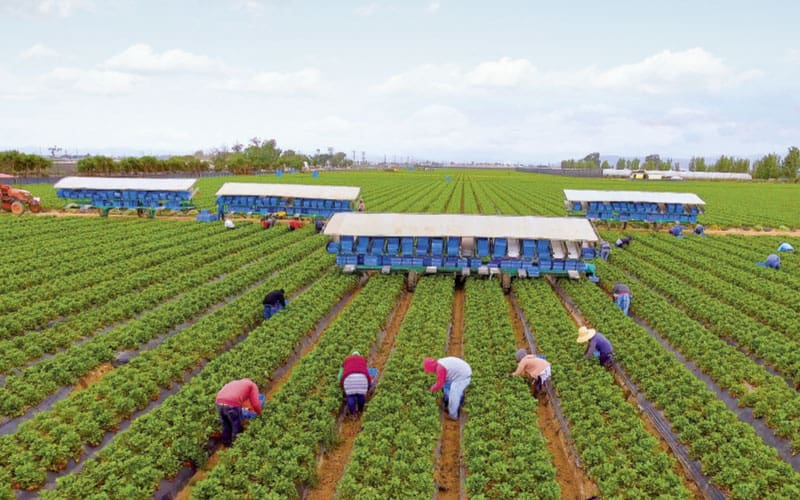
Workers harvest berries at EFI-certified GoodFarms, in Oxnard, California.
© ANDREW & WILLIAMSON
Empowering the farmers
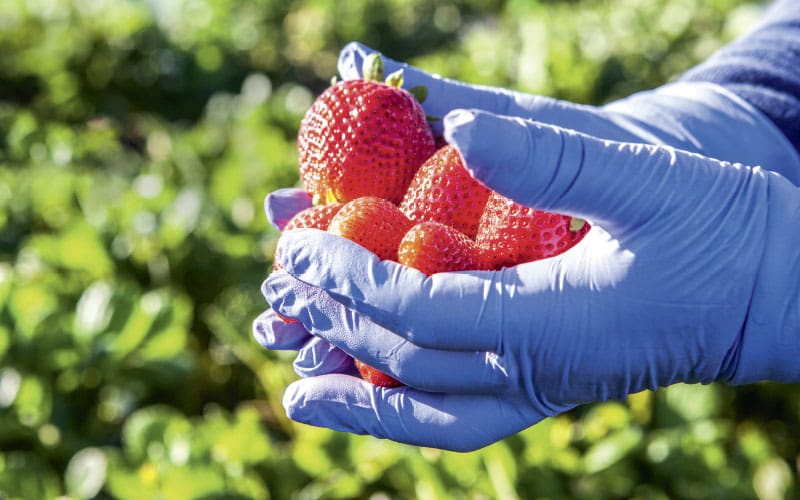
Eleven years ago, El Milagro de Baja partnered with Equitable Food Initiative (EFI; equitablefood.org), a non-profit certification program focused on improving working conditions for farmworkers and raising agricultural standards internationally. El Milagro de Baja supplies strawberries to Costco through its parent company, Andrew & Williamson Fresh Produce, under the GoodFarms brand.
The organization provides workers with updated training on health and food safety regulations, including hygiene, proper hand-washing and sanitation. Workers are also trained on how to identify sexual harassment in the workplace and on health and safety issues, including injury prevention, with instructions on warm-up exercises and proper use of equipment, such as carts to transport the produce.
Being part of the organization enabled the farms to act quickly when health and safety guidelines were updated during the pandemic. For example, Andrew & Williamson increased sanitizing of communal areas, carts and tools, farmworkers wore personal protective equipment, such as face coverings and gloves, and practiced social distancing.
Similarly, 16 years ago, banana supplier Equifruit, located in Montreal, partnered with Fairtrade (fairtrade.ca), a global non-profit certification system that set standards for better prices, decent working conditions and fair terms of trade. Since 2021, Equifruit has supplied Costco warehouses in the Toronto area with organic and Fairtrade-certified bananas from two cooperatives. Appbosa is a cooperative made up of 555 small producers farming collectively in Peru and employing 385 community members. Asoguabo is a cooperative located in Ecuador founded by a group of small-scale farmers, which has grown to 132 banana farms.
Cooperatives band together jointly to invest in communal improvements, such as produce packing stations, and create quality control and certification review teams building export relationships with Fairtrade licensees, says Jennie Coleman, president and owner of Equifruit. Cooperatives and suppliers work with Fairtrade to eradicate outdated banana business practices.
“When we look at how low prices for bananas at production level are achieved, they’re often achieved through cutting corners on wages for workers, investments in working conditions for workers and on environmental practices. And so under Fairtrade we don’t want to see those corners cut,” says Coleman. “We want to be proud to stand behind a product which doesn’t reflect that kind of toxic, 100-plus-year-old way of doing business. And while this might make a Fairtrade banana a little bit more expensive, it is still a very, very affordable fruit.”
A worker shows off a banded bunch of Fairtrade-certified Equifruit organic bananas.
© andre bull
A worker at one of Equifruit’s small producer partners in Ecuador manages the process of removing latex, a kind of sap, from the stems of freshly cut bananas.
© ANDRE BULL
Protecting the environment
In addition to improving farmworker conditions, EFI and Fairtrade support lessening the environmental impacts of agricultural businesses.
Farms are expected to reduce the amount of pesticides used on crops in conjunction with pesticide-management tactics. For example, farm-friendly insects, such as ladybugs, are introduced to eat other pests that are harmful to crops. Marigolds planted at the end of rows deter unwanted insects. Strips and boxes holding a liquid that attracts and traps pesky insects are placed around the perimeters.
Some farms also use vacuum-cleaner-like machines that suck up unwanted pests. Others have microbiology teams that produce beneficial fungi, which are applied to the soil to fight pathogens that are harmful to plants. And others use rainwater reservoirs or water desalination plants to help with water management, providing water for the crops through drip irrigation systems or micro sprinklers instead of traditional sprinkler systems, where about 60% of the water is carried away by wind or lost to evaporation.
For example, the Appbosa cooperative built a water supply system that collects 30% of the water used on the plantation that was previously washed away. The run-off water is used for the bananas and improves productivity by cutting the amount of time it takes to water the crops from four hours to two.
How Fairtrade works
Fairtrade’s approach enables farmers and workers to have more control over their lives and decide how to invest in their future, says Julie Francoeur, CEO of Fairtrade Canada. Produce with the Fairtrade mark means producers and businesses have met internationally agreed upon standards, which have been independently certified. Farmers and workers have a strong voice at every level of Fairtrade, from how they invest in and run their local organizations to having an equal say in Fairtrade’s global decision-making.
“Fairtrade is more than just about certification. It’s a movement for change that believes farmers and workers know what’s best for their businesses and for their communities. It’s about redistributing the power in supply chains and ensuring they have an equal say,” Francoeur says.
The Fairtrade Minimum Price aims to cover the average costs of producing sustainable crops. The Fairtrade Premium, an extra sum of money paid on top of the selling price to invest in business or community projects. Between November 2021 and January 2023, more than $245,670 from cases of bananas purchased by Costco has gone back to the cooperatives in Peru and Ecuador.
Since 2003, the farmers of Appbosa have invested in local schools, health centres, potable running water for homes, a women’s leadership and entrepreneurship workshop and a cable-way system for banana transportation from the farm to packing stations and refrigerated storage facilities. Asoguabo has invested in initiatives, such as equipping children with school bags, providing retirement care for seniors, building schools for disabled children, providing a shelter for victims of sexual violence and ensuring the safety of drinking water.
El Milagro de Baja farm head security guard Alfonso Santiago Velazco / A hand-washing station at Rancho Don Juanito, an EFI-certified strawberry farm, in San Quintín, Mexico.
© EDGAR PINTO / © CHRISTINA GUERRERO
The EFI approach
EFI’s approach also focuses on empowering farmworkers at all levels to help solve issues on the farms.
“The EFI structure helps change the culture on the farm,” explains LeAnne Ruzzamenti, the organization’s director of marketing communications. “We create an open, trustworthy culture where farmworkers are engaged and have a voice, which improves working conditions throughout the whole farm.”
An elected leadership team of farmworkers and managers is trained in communication, collaboration and problem-solving skills, and then applies those skills to help the farming operation meet EFI standards, which focus on working conditions, food safety and pest management.
From the consumers’ perspective, the EFI certification on fruits and vegetables signifies that the workers harvesting the produce have been treated respectfully and compensated fairly, says Ruzzamenti. And growers are assured that the workforce has been given the skills and support to address critical issues like food safety and traceability, so they can excel in a global marketplace.
Currently, 54 farms have been certified (26 in Mexico, 24 in the U.S., three in Canada and one in Peru) and 10 more are pending certification with leadership trained. This means more than 55,000 workers are on farms with trained EFI teams.
Farms in Canada and other countries certified by EFI are paid a premium by retailers for produce meeting the requirements of the programs. The premium on certified produce appears on the workers’ checks as an EFI bonus. Since 2017, the program has generated over $19 million in farmworker bonuses.
Growers also benefit from engaged workers who report higher work satisfaction and help solve issues. Amalia Zimmerman-Lommel, director of social responsibility for Andrew & Williamson Fresh Produce, says the program relieves pressure on farm managers, because now the workforce is communicating, collaborating and problem-solving. That in turn increases productivity and quality.
“No person or situation is perfect, so continuous improvement is part of this culture change,” Zimmerman-Lommel says. “The culture change goes both ways, from the workforce to top management, there is improvement for all and everyone participates in improving processes with clear and transparent communication.”
© EQUIFRUIT
Annual audits
Both EFI and Fairtrade work with a third-party certified auditing body to verify the farms follow the standards set by each organization. When audits are completed and farms are certified, which can vary in length of time depending on the number of workers, the farms are allowed to label produce as coming from a certified supplier. Annual audits, which include worker interviews, are conducted to ensure the farms remain in compliance and any new workers have been trained.
The certificate holder is responsible for reporting to the non-profit, as well as the committees, the amount of product sold. This determines the amount of premiums generated, which are evaluated and audited as well.—CG
Produce at Costco
Costco supports Equitable Food Initiative (EFI) and Fairtrade by paying the premium for certified produce, which is labelled with a mark. The Costco buying team encourages suppliers to participate in those programs.
EFI and Fairtrade each provide a verifiable program that helps enrich the lives of agricultural workers while empowering them to harvest a better-quality product for Costco, where possible.—CG
Costco Connection: Look for Equitable Food Initiative- and Fairtrade-certified food in your local Costco warehouse.
